
Weighted Wheel: Give Each Entry Its Own Odds
A weighted wheel is a spinner where every entry carries a weight, so some entries are more likely to be picked than others. An entry’s probability is its weight divided by the total of all the weights. Weights of 5, 3 and 2 give odds of 50%, 30% and 20%. This page explains how those weights turn into odds, what changes when a winner is removed, and how to run a weighted draw that other people can check for themselves.
Weighted Wheel
Your entries and history stay in this browser. No participant data is sent to a server.
Winner
The wheel could not load. Try a current browser or reload this page.
Wheel settings
Winner history
The last 100 winners are saved in this browser.
How to Use a Weighted Wheel
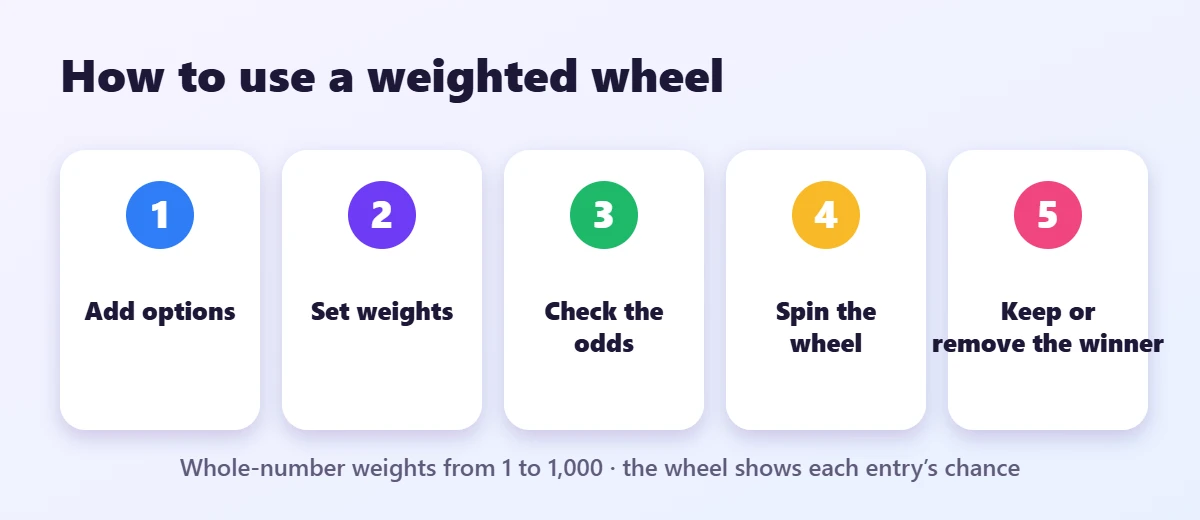
- Enter your options. Add one entry for each thing the wheel can pick: a name, a prize, a task or a choice.
- Give each option a weight. A bigger number means a bigger share of the odds. Use whole numbers from 1 to 1,000, and give every entry the same weight if you want equal odds.
- Check the odds before you spin. The wheel shows each entry’s chance beside its weight. You can also check it yourself: add up all the weights, then divide each entry’s weight by that total. If the shares are not what you meant, change the weights now rather than after the result.
- Spin and read the result. The pointer shows which entry was selected.
- Decide whether the winner stays. Keeping the winner leaves every probability unchanged. Removing the winner changes the total, so the remaining entries’ odds change too. Use the Remove Winner button, or turn on Auto-remove winner after each spin, to take winners off the wheel.
A weight describes likelihood across many spins. It does not tell you what the next spin will do, and a low-weight entry can win the very first spin.
What Is a Weighted Wheel?
A weighted wheel is a random picker in which options have different probabilities. On a standard spin the wheel gives every entry an equal slice. With four entries, each has a 25% chance. On a weighted wheel you attach a number to each entry, and that number sets how much of the odds the entry receives.
The word “weighted” can mean other things, so it helps to be precise. In this page it means a software selection method in which options carry different probabilities. It does not refer to a physical wheel with added mass, such as a flywheel or a balanced tire. It also does not mean a wheel whose odds are hidden from the people watching. The weights here are numbers you choose and can show to everyone.
You will see the same idea under other names. A probability wheel makes the odds the main subject. A weighted randomizer puts the emphasis on the selection step rather than the animation. A prize wheel usually has a few big prizes that should be rare and many small outcomes that should be common. They all rest on the same arithmetic, which the next sections cover.
Three ideas do most of the work:
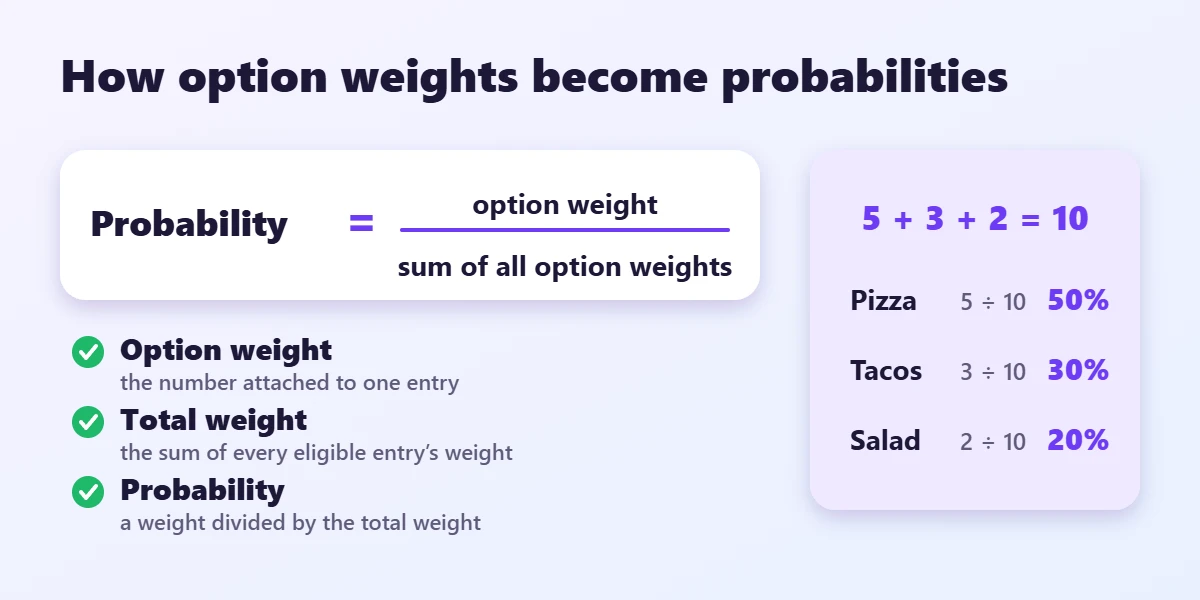
- Option weight: the number attached to one entry.
- Total weight: the sum of the weights of every entry that is currently eligible.
- Probability: an entry’s weight divided by the total weight, shown as a fraction or a percentage.
How Option Weights Become Probabilities
The Formula
For any entry on the wheel:
Probability = option weight ÷ sum of all option weights
The formula works when every weight is zero or higher and the total is greater than zero. A weight of zero gives an entry a probability of zero, which is the same as leaving it off the wheel. Negative weights and a total of zero do not define a probability, so they have no sensible meaning on a wheel. In this tool, weights are whole numbers from 1 to 1,000, so to leave an entry out of a spin, untick it instead of giving it a weight of zero.
Worked Example: Weights of 5, 3 and 2
Suppose a team picks a lunch spot with three options. Pizza gets a weight of 5, tacos get 3 and salad gets 2.
- Add the weights: 5 + 3 + 2 = 10. The total weight is 10.
- Divide each weight by 10.
| Option | Weight | Calculation | Probability |
|---|---|---|---|
| Pizza | 5 | 5 ÷ 10 | 50% |
| Tacos | 3 | 3 ÷ 10 | 30% |
| Salad | 2 | 2 ÷ 10 | 20% |
| Total | 10 | 100% |
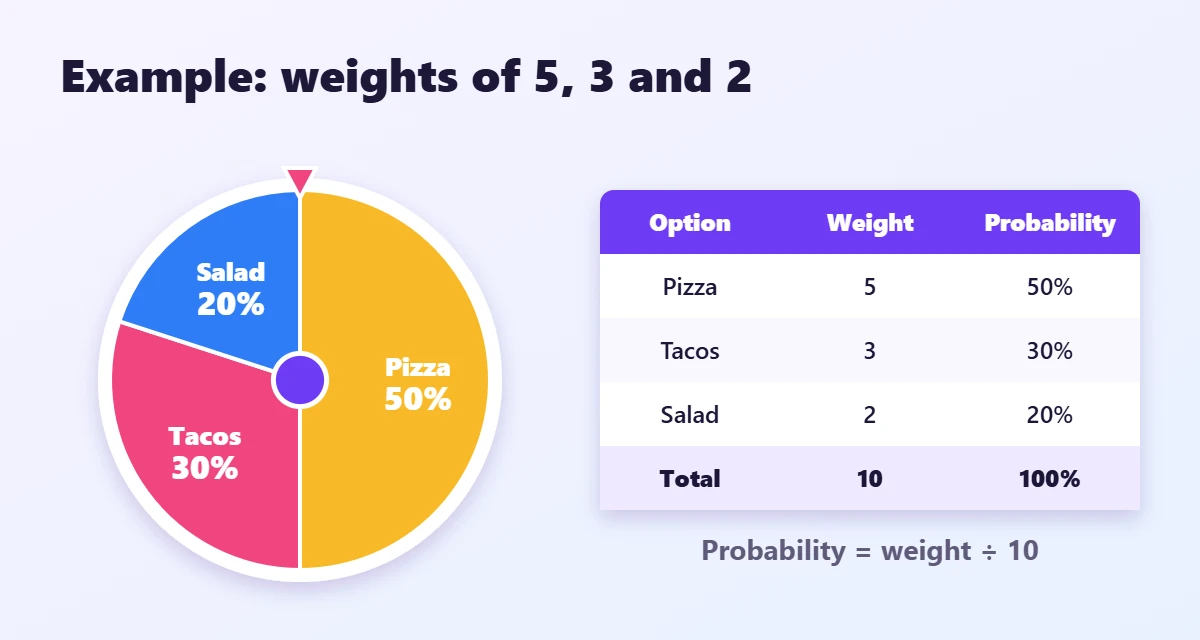
The probabilities always add up to 100% because each one is a share of the same total.
Weights Are Relative, Not Absolute
Only the ratio between weights matters. Weights of 10, 6 and 4 give exactly the same odds as 5, 3 and 2, because the total is now 20 and each share is still 50%, 30% and 20%. Weights of 50, 30 and 20 do the same.
This has a practical side. You can choose small, easy numbers and let the arithmetic do the rest. It also means one weight alone tells you nothing. A weight of 10 is a 50% chance when the total is 20 and only a 25% chance when the total is 40. Always judge an entry against the full list.
Here is how common two-entry ratios turn into odds:
| Weight ratio (A : B) | Chance of A | Chance of B |
|---|---|---|
| 1 : 1 | 50% | 50% |
| 2 : 1 | 66.67% | 33.33% |
| 3 : 1 | 75% | 25% |
| 4 : 1 | 80% | 20% |
| 9 : 1 | 90% | 10% |
Percentages here are rounded to two decimal places. The exact value for 2 : 1 is two thirds and one third.
Weights Versus Percentages
You can describe the same wheel with weights or with percentages. Weights of 5, 3 and 2 and percentages of 50, 30 and 20 are the same wheel. Percentages are easier to say out loud to an audience: “a 20% chance” is clearer than “a weight of 2 out of 10”. Weights are easier to maintain, because when you add or remove an entry you do not have to rebalance everything so it still totals 100.
A simple habit works well: build the wheel with small whole-number weights, then read the resulting percentages aloud before spinning.
Why Displayed Percentages Can Total 99.99% or 100.01%
Probabilities are exact fractions, but screens show rounded numbers. Three entries with equal weights each have a probability of one third. Rounded to two decimals, each shows as 33.33%, and the three displayed values add up to 99.99%. Seven equal entries each show 14.29%, which adds up to 100.03%.
Neither case is an error in the odds. The rounding happens only in the display. The underlying chance for each entry is still exactly its weight divided by the total.
A Larger Probability Table
Here is a four-entry wheel with weights of 4, 3, 2 and 1. The total weight is 10.
| Entry | Weight | Probability |
|---|---|---|
| Alpha | 4 | 40% |
| Bravo | 3 | 30% |
| Charlie | 2 | 20% |
| Delta | 1 | 10% |
| Total | 10 | 100% |
Alpha is four times as likely as Delta on each spin, and twice as likely as Charlie. Those ratios between entries stay the same as long as nothing on the wheel changes.
Weighted Wheel vs. Equal-Odds Wheel
| Aspect | Equal-odds wheel | Weighted wheel |
|---|---|---|
| Chance per entry | 1 divided by the number of entries | Entry weight divided by total weight |
| What you set up | A list of entries | A list of entries and a weight for each |
| Best for | Interchangeable choices, such as picking one student or one volunteer | Choices that should not be equally likely, such as bonus entries or prize tiers |
| Easy to explain | Yes, everyone has the same chance | Yes, if the weights are shown |
| Main risk | Treating unequal situations as equal | Hiding or changing the weights |
Choose the equal-odds version when the entries truly are interchangeable. A random name picker that gives every person the same chance is the right tool for choosing who answers the next question. Choose a weighted wheel when there is a real reason for entries to differ, and when you are willing to show that reason.
Duplicate Entries vs. Weights
You can give one choice better odds without any weight feature by entering it more than once. If a wheel treats each entry as a separate equal chance, then Ali, Ali, Sara and John gives Ali two of four entries. That is 50% for Ali and 25% each for Sara and John.
A weight of 2 on a single Ali entry gives the same result: Ali has weight 2, Sara 1 and John 1, so the total is 4 and Ali’s share is 50%. The two methods match when each duplicate carries the same weight as a single entry. They differ in convenience:
- Duplicates clutter the list and make it easy to miscount. Changing someone from 3 chances to 5 means adding two more rows.
- Weights keep one row per option and make the odds easy to read and edit.
- Removing a winner behaves differently. If you remove only the selected row, the other duplicate rows with the same name stay on the wheel. If you remove a weighted entry, its whole weight leaves at once.
Also be careful about whose probability you are describing. If duplicate rows belong to one person, the probability of that person is the combined probability of all their rows, not the probability of any one row.
What Happens When You Remove a Winner
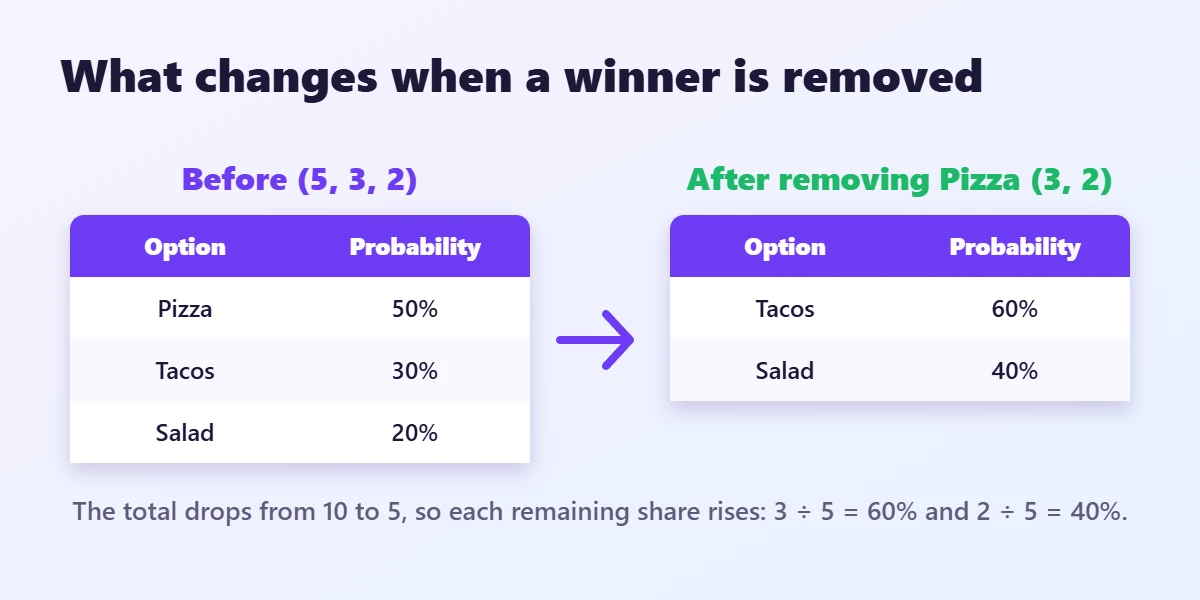
Removing a winner changes the total weight, so every remaining probability changes. The weights of the remaining entries do not change. Only the total they are divided by does.
Take the four-entry wheel with weights of 4, 3, 2 and 1, and suppose Alpha wins and is removed. The remaining weights are 3, 2 and 1, and the new total is 6.
| Entry | Before (total 10) | After removing Alpha (total 6) |
|---|---|---|
| Alpha | 40% | removed |
| Bravo | 30% | 50% |
| Charlie | 20% | 33.33% |
| Delta | 10% | 16.67% |
Everyone left gains probability, because the removed entry’s share is redistributed in proportion to the remaining weights. Bravo and Charlie keep the same relationship to each other: Bravo was one and a half times as likely as Charlie before, and still is.
The result depends on who is removed. If Bravo had won instead, the remaining weights would be 4, 2 and 1, with a total of 7. Alpha would then have 4 out of 7 (57.14%), Charlie 2 out of 7 (28.57%) and Delta 1 out of 7 (14.29%).
The Formula After a Removal
When entry j is removed and the original total weight is W, the chance of any remaining entry i on the next spin is:
P(i next, given that j was removed) = weight of i ÷ (W − weight of j)
This holds when the other weights are unchanged and the new total is greater than zero.
Order Matters Without Replacement
When winners are removed, a series of spins is no longer a series of identical draws. Using the four-entry wheel, the probability that Alpha is drawn first and Bravo second is 4/10 × 3/6 = 20%. The probability that Bravo is drawn first and Alpha second is 3/10 × 4/7, which is about 17.14%. The same pair of entries has a different probability in a different order, because the denominator after the first draw depends on who left.
This matters if you draw several winners in sequence and want to say what the odds were for each place. Calculate each step from the entries that are left at that step.
Are Weighted Spins Independent?
Spins are independent only when the selection method makes each draw separately and the weights stay the same between draws. Under those conditions, nothing that happened on the last spin changes the odds of the next one. A wheel does not owe a high-weight entry a win, and a low-weight entry does not become “due”.
Two things break independence:
- Removing winners. The pool shrinks, so later draws depend on earlier ones.
- Changing weights or entries between spins. The probabilities are no longer the same from one spin to the next.
If the entries and weights are unchanged and no one is removed, you can use simple probability rules. For an entry with probability p, the chance that it comes up at least once in n spins is:
1 − (1 − p)^n
For an entry with a 20% chance, five spins give 1 − 0.8^5, which is about 67.23%. That is not a guarantee. The chance that it never appears in those five spins is about 32.77%.
The same assumption gives the chance of seeing the same entry twice in a row. With weights of 5, 3 and 2, the chance that two consecutive spins match is 0.5² + 0.3² + 0.2² = 0.25 + 0.09 + 0.04 = 38%. Repeats are a normal part of random selection, and a repeat alone is not evidence that anything is wrong.
These calculations describe the mathematics of independent draws. Whether any particular wheel actually behaves that way depends on how it is built, which is why a wheel that shows its rules is easier to trust than one that only shows an animation.
Fair Weighted Selection vs. Secretly Manipulated Odds
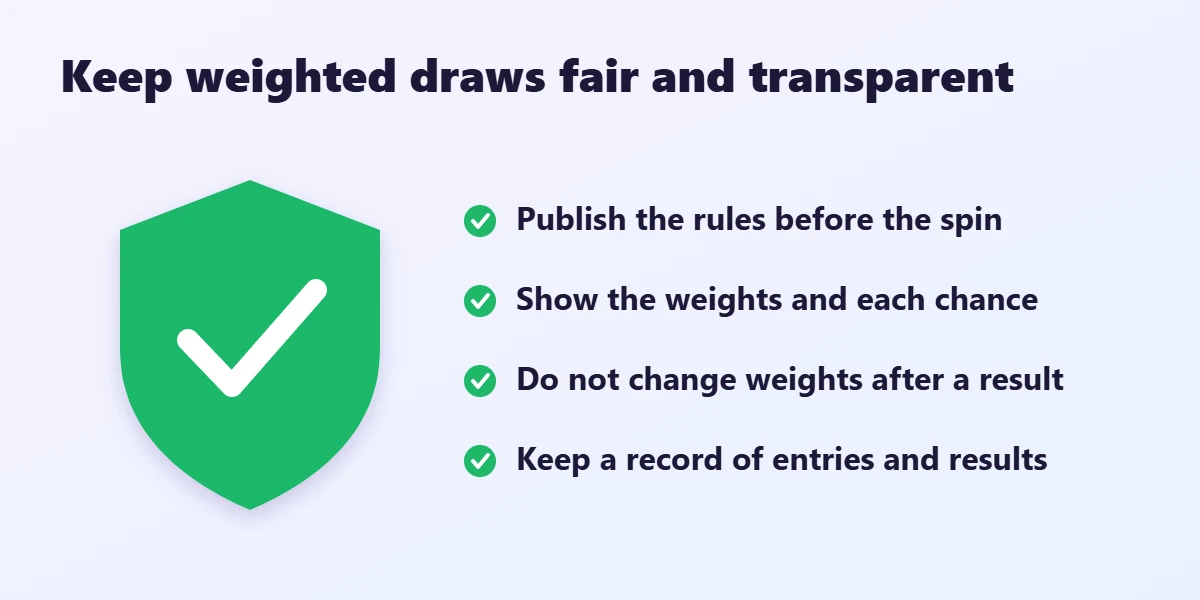
Unequal odds are not unfair by themselves. A weighted wheel is fair in the ordinary sense when the rules are stated in advance, everyone can see the weights, the same method applies to everyone, and the weights are not changed after the spin.
A wheel is secretly manipulated, or rigged, when its odds are hidden from the people relying on the result or are changed without telling them. The problem is the concealment, not the inequality. Announcing a draw where everyone has the same chance and then quietly weighting one entry is misleading. Announcing that referral bonuses earn extra entries and showing each person’s weight is not.
A few habits keep a weighted draw honest:
- Publish the rule before the spin. For example: “Each ticket is worth one weight point, and each referral adds two.”
- Show the weights and the total. If someone wants to verify the odds, they should be able to divide it out themselves.
- Do not change weights after seeing a result. Decide the weights first.
- Keep a record. For a draw that matters, save the list of entries and weights alongside the result.
- Say whether winners are removed. This changes the odds for later draws.
A spin animation is a presentation. What decides fairness is the selection process and the stated rules, not how long the wheel turns or how dramatically it slows.
How Weighted Random Selection Works
Most weighted pickers use some form of the same method, often called roulette-wheel selection or fitness-proportionate selection in computer science. The idea is to lay each entry’s weight along a number line and pick a random point on it.
- Add up the weights to get the total.
- Build running totals. For weights of 5, 3 and 2, the running totals are 5, 8 and 10.
- Pick a random number from zero up to, but not including, the total.
- Choose the first entry whose running total is greater than that number. A number below 5 selects the first entry, a number from 5 up to 8 selects the second, and a number from 8 up to 10 selects the third.
Because the first entry covers five units of a ten-unit line, it is chosen for half of all possible random numbers. That is the 50% probability from the formula.
A reference on this method describes the basic version as building the running totals and looking up the random number among them. It adds that a binary search makes that lookup fast for long lists, and that the alias method can pick in constant time after some preparation. There is also a stochastic-acceptance variant, which picks an entry at random and then accepts it with a probability based on its weight. For a wheel with a few dozen entries, the speed differences are not noticeable. What matters for fairness is that the random numbers are good and that they are mapped to entries without distortion.
Where the Random Number Comes From
A browser can produce random values through the Web Crypto method crypto.getRandomValues(). According to MDN, it returns cryptographically strong random values, but implementations use a pseudo-random generator seeded with a high-entropy source rather than a physical random process, and the specific algorithm can vary between browsers. Math.random() is described there as a non-cryptographic source. For a wheel, the practical point is that a better source is harder to predict.
Avoiding Bias in the Mapping
Turning a random integer into a choice can introduce a small bias if the range does not divide evenly. A common fix is to discard values from the uneven leftover part of the range and draw again, so that every accepted value maps to the entries evenly. This is a standard technique and is worth looking for when a tool describes how it picks winners. If you are curious how the standard equal-odds wheel on this site handles it, the article How Random Wheels Work walks through it in plain language.
Weighted Wheel Examples and Use Cases
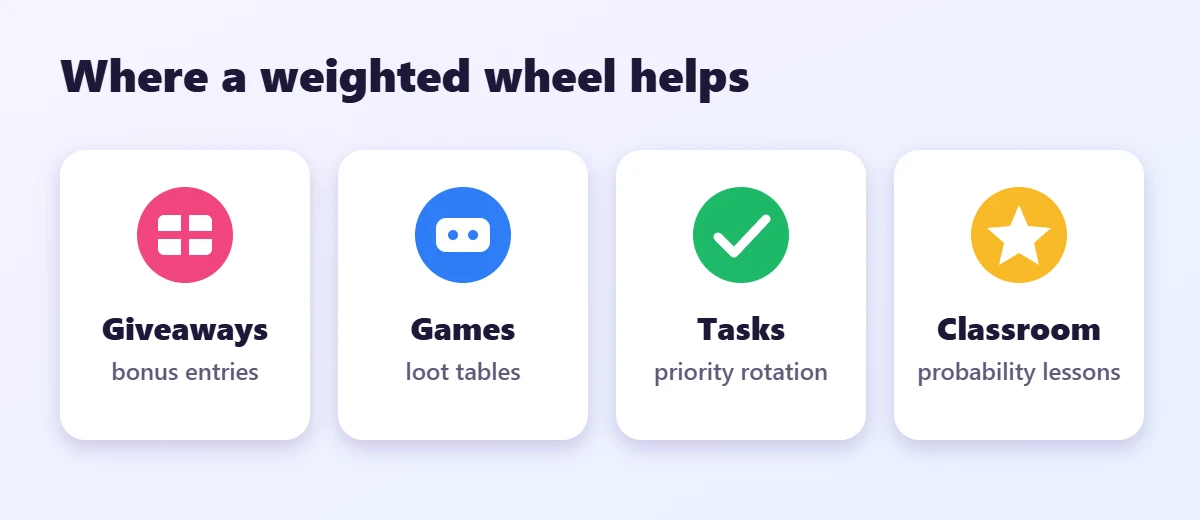
Bonus Entries for a Giveaway
In a giveaway, people sometimes earn extra chances by completing extra steps. Suppose the rules say a base entry is worth 1, a referral adds 2 and a verified purchase adds 5. A person with a base entry and one referral has weight 3. Someone with a base entry, a referral and a purchase has weight 8. If the total weight across all entrants is 200, the second person has an 8 ÷ 200 = 4% chance on a single draw.
Showing the rule and each entrant’s weight makes this kind of draw easy to defend. Rules for sweepstakes and prize promotions differ by place and by how entry is earned, so check the requirements that apply to you before you run one.
Prize Tiers
A prize wheel often has one rare grand prize and many small outcomes. Suppose the weights are:
| Outcome | Weight | Probability |
|---|---|---|
| Grand prize | 1 | 1% |
| Gift card | 4 | 4% |
| Coffee | 15 | 15% |
| Sticker | 30 | 30% |
| Try again | 50 | 50% |
| Total | 100 | 100% |
Over 200 spins that keep the same weights, the expected counts are 2 grand prizes, 8 gift cards, 30 coffees, 60 stickers and 100 “try again” results. Those are expectations, not promises. The chance of at least one grand prize in 200 spins is 1 − 0.99^200, or about 86.6%, which also means about a 13.4% chance of none.
Choosing weights that add up to 100 makes the weights read as percentages, which is convenient when you need to tell participants the odds.
Task Rotation by Priority
A team can use a weighted wheel to decide what to work on next without always choosing the same thing. Give urgent work a weight of 5, important work 3 and optional work 1. Urgent tasks come up more often, but the wheel still surfaces the others from time to time. This works best for tasks of similar size where variety is welcome. It is a poor fit when something truly must be done first.
A Classroom Probability Lesson
A weighted wheel is a visual way to show that probability describes long-run frequency. Give students a wheel with weights of 3, 2 and 1, so the odds are 50%, 33.33% and 16.67%. Ask them to predict how many times each outcome will appear in twelve spins, run the spins, then compare the counts with the expectation.
Twelve spins is a small sample, and the counts will usually drift from 6, 4 and 2. That gap is the lesson. Running more spins usually brings the observed shares closer to the expected ones, though it never guarantees an exact match.
Game Design and Loot Tables
Game designers use weighted tables so that common rewards appear often and rare ones seldom. A table with weights of 70, 20, 8 and 2 is a quick way to prototype how a reward system feels before building it. Because the weights total 100, they read directly as percentages.
Choosing Between Good Options
If you lean toward one option but want to leave room for an alternative, a modest weight can express that lean. Giving a preferred restaurant a weight of 3 against 1 for two others makes it 60% likely and each alternative 20%. It keeps the final step random without pretending the options are equal.
Choosing Sensible Weights
Weights work best when each one has a reason you can state.
- Start with small whole numbers. Weights such as 1, 2, 3 and 5 are enough for most purposes and are easy to check by hand.
- Avoid extreme ratios unless you mean them. A weight of 100 against 1 gives the smaller entry a probability just under 1%. That is right for a rare prize and wrong if you want both choices to stay competitive.
- Keep the total in view. Adding an entry lowers every other entry’s share, even though their weights did not change.
- Untick instead of using zero. In the formula a weight of zero gives a probability of zero, but this wheel’s weights run from 1 to 1,000, so an entry you want out of a spin is switched off with its checkbox.
- Write down the reason for each weight. If you cannot explain why an entry has a higher weight, reconsider whether the wheel should be weighted at all.
- Test with a few practice spins, but do not over-read them. A small number of spins will not match the percentages closely.
When Not to Use a Weighted Wheel
Use a different approach when:
- Everyone should have the same chance. Use an equal-odds picker, and enter each person once.
- The decision involves health, safety, legal duties or serious financial consequences. Evidence and professional advice should decide those, not a spin.
- You cannot show the weights. A hidden weighting that people would object to is manipulation, not a feature.
- You need to split people into balanced groups. Group or team tools are designed for that job.
- You need an auditable, certified draw. A wheel on a web page is not a substitute for a regulated or independently verified process.
Weighted Wheel FAQ
Find quick answers to the most common questions about our spinning tools.
What is a weighted wheel?
A weighted wheel is a random spinner where each entry has its own weight, and the weight sets how likely that entry is to be selected. Entries with larger weights are chosen more often over many spins.
How do you calculate probability on a weighted wheel?
Divide an entry’s weight by the sum of all weights. With weights of 3, 2 and 1, the total is 6, so the entries have probabilities of 50%, 33.33% and 16.67%.
Do the weights need to add up to 100?
No. Weights are relative, so 5, 3 and 2 give the same odds as 50, 30 and 20. Using weights that total 100 is only a convenience, because they then read directly as percentages.
Does the highest weight always win?
No. The highest weight gives the best chance on each spin, never a certainty. An entry with a 70% chance still misses on 3 spins in 10, on average, and a 5% entry can win the first spin.
What happens to the odds if I remove a winner?
The total weight drops by the winner’s weight, so every remaining entry’s probability rises. The weights themselves stay the same, and the ratios between the remaining entries do not change.
Are weighted spins independent?
They are independent only when each draw is made separately and the entries and weights are unchanged between draws. Removing winners or editing weights makes later draws depend on earlier ones.
How are duplicate entries different from weights?
Both can raise an entry’s chance. Duplicates add extra rows, while a weight changes one row’s share. They match when each duplicate carries the same weight as a single entry, but weights are easier to read and edit.
Can I use a weight of zero?
A weight of zero gives the entry a probability of zero, which is the same as leaving it off the wheel. Negative weights have no meaning as probabilities, and a total of zero leaves nothing to select. On this wheel, weights are whole numbers from 1 to 1,000, so untick an entry to leave it out of a spin.
Is a weighted wheel fair?
It can be, when the rules and weights are stated in advance, shown to everyone and applied the same way each time. A weighted wheel is unfair when the odds are hidden or changed after the fact.
Can I use a weighted wheel for a giveaway?
Yes, if the entry rules are clear and the weights are visible. Check the rules that apply to prize promotions where you are before you run one, and keep a record of the entries and weights.
How many spins before results match the weights?
There is no set number. Observed shares tend to move closer to the expected percentages as spins increase, but short runs often look uneven. Twelve spins on a 50% entry give exactly six hits only about 23% of the time.
What is the difference between a weighted wheel and a random name picker?
A random name picker usually gives every name the same chance. A weighted wheel lets you set different chances for different entries. Use an equal-odds picker when everyone is interchangeable.
No questions match your search.
Related Tools and Guides
Different jobs call for different tools on Wheel of Names:
- For equal-odds spinning of names or any list, use the Wheel of Names homepage.
- To choose between acceptable options, try the Decision Wheel.
- For a quick two-way answer, use the Yes or No Wheel.
- To draw winners, see the Raffle Picker and the Giveaway Picker.
- To understand how random selection and fairness work in general, read How Random Wheels Work.
- To see how random choice fits everyday decisions, read Random Decision Making.
Sources
- MDN Web Docs, Crypto: getRandomValues() method, opened 2026-11-02. Used for the statement that the method returns cryptographically strong values from a seeded pseudo-random generator whose algorithm may vary between browsers.
- Wikipedia, Fitness proportionate selection, opened 2026-11-02. Used for the running-total method, binary-search and alias-method speed notes, and the stochastic-acceptance variant.